Every generic travel guide tells you to avoid the monsoon. Meghalaya is the exception, and it is not a small one. This is one of the wettest places on earth, and the same rain everyone else’s itinerary is built around avoiding is exactly what turns Cherrapunji’s waterfalls into the roaring, full-force version worth actually travelling to see. At Flywings Tour & Packages Pvt Ltd, we are seeing a genuine shift in how our Chandigarh clients think about this destination, less “when can we avoid the rain” and more “we specifically want to see it at its wettest.” This guide is built around that shift. We checked the top-ranking “Meghalaya package from Chandigarh” results while researching this piece, and every one of them defaults to the standard winter-only recommendation without acknowledging that Cherrapunji’s entire identity, the wettest inhabited place on the planet, is genuinely wasted if you only ever see it dry.
What “Wettest Place on Earth” Actually Means Here
Mawsynram and Cherrapunji have traded the record for highest annual rainfall on the planet for decades, and the numbers are genuinely staggering, some years recording rainfall in the range of tens of feet rather than inches. That statistic is not just trivia, it is the reason the region’s waterfalls, root bridges, and river systems look the way they do. A living root bridge exists because Khasi communities needed a way to cross streams that regularly become impassable during monsoon, and seeing that context firsthand, rather than reading it as a fact on a signboard, is part of what makes a monsoon-season visit worth the extra rain gear.
Quick context: Indian tourists need no permit at all for the standard Meghalaya circuit, Shillong, Cherrapunji, Mawlynnong, and Dawki, just a valid photo ID. Combined with genuinely accessible connectivity via Guwahati, this is one of the easiest Northeast India destinations to plan on relatively short notice.
Why Monsoon Season Is the Actual Peak, Not the Season to Avoid
Most of India times a trip around avoiding the June-to-September monsoon. Meghalaya inverts that logic entirely. Cherrapunji and nearby Mawsynram are among the wettest places on the planet, and the region’s defining sights, waterfalls, living root bridges, dramatic valley views, are all shaped by that rainfall. A dry-season visit to Cherrapunji sees a fraction of the water flow that makes Nohkalikai Falls and Seven Sisters Falls genuinely spectacular. The “monsoon tourism” shift gaining traction now is really just travellers catching up to what locals have known for a while: this is the season the landscape is actually built for.
No Permit Needed, a Real Advantage Over Much of the Northeast
Unlike Sikkim’s North Sikkim zones, or Nagaland and parts of Arunachal Pradesh, Meghalaya requires no Inner Line Permit or Protected Area Permit for Indian tourists anywhere on the standard circuit. A valid government photo ID is enough for Shillong, Cherrapunji, Mawlynnong, and Dawki. If you have found permit logistics elsewhere in the Northeast a genuine barrier to short-notice planning, Meghalaya removes that friction entirely, one of the reasons it pairs so naturally with a destination like our Jorhat and Majuli guide for travellers building a broader Northeast itinerary.
Getting There from Chandigarh
There is no direct flight from Chandigarh, and Shillong’s own Umroi Airport has limited connectivity, mostly to Kolkata. The reliable route runs through Guwahati, well connected to Delhi with multiple daily flights, followed by a road journey of roughly three hours to Shillong. From Chandigarh, that means a domestic hop to Delhi, a direct flight to Guwahati, and a scenic drive into the Khasi Hills.
The Circuit
Shillong, 1 to 2 Days
Meghalaya’s capital, often called the Scotland of the East for its rolling hills and colonial-era charm. Ward’s Lake, the Shillong Peak viewpoint, and the local cafe culture around Police Bazaar make for an easy first day or two before heading toward the wetter, more dramatic landscapes further south.
Cherrapunji (Sohra), 2 Days
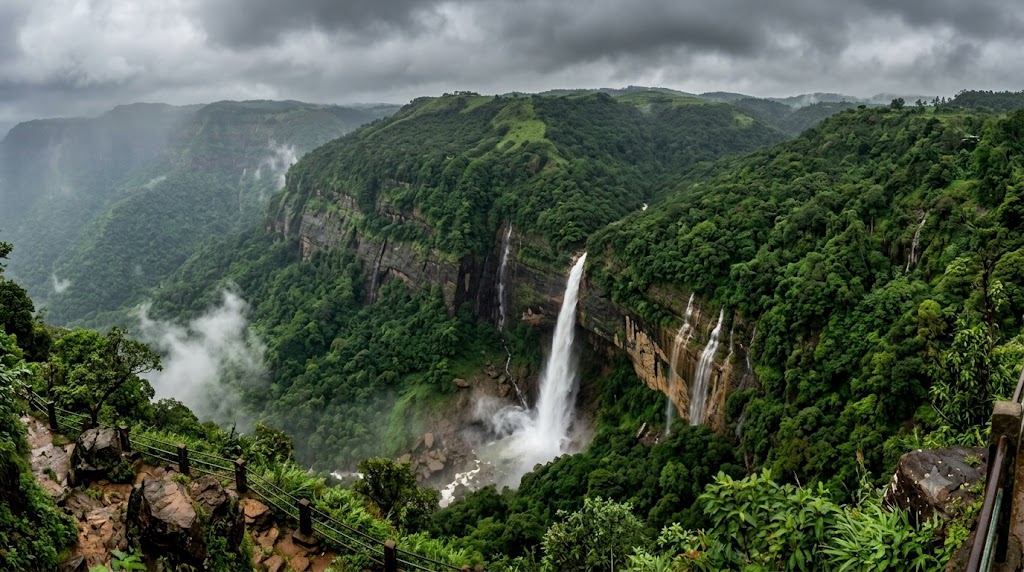
The heart of the trip. Nohkalikai Falls, one of India’s tallest waterfalls, and Seven Sisters Falls both run at their most powerful during monsoon season. The Mawsmai Caves offer a different kind of experience entirely, limestone caverns you can walk through, a good option if a heavy rain day makes outdoor sightseeing less appealing.
The Living Root Bridges, Half to Full Day
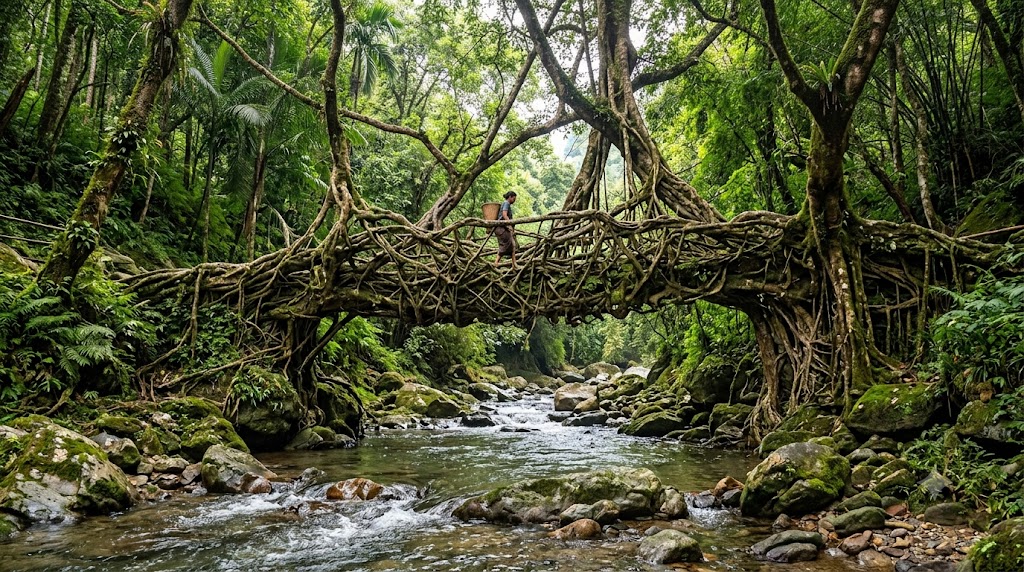
The signature experience of the entire trip. Grown over generations by the Khasi and Jaintia people by training rubber tree roots across streams, these bridges are genuinely load-bearing and still in daily use by local villages. The double-decker root bridge near Nongriat is the most famous, reached by a steep trek down thousands of steps and back up, a proper half-day commitment that rewards the effort. Simpler single root bridges near Riwai, close to Mawlynnong, offer a much easier alternative for anyone not up for the full Nongriat trek.
Mawlynnong, Half Day
Frequently cited as Asia’s cleanest village, and worth the visit for the atmosphere alone, spotless pathways, traditional Khasi architecture, and a genuinely different pace from anywhere else on the circuit. The nearby Sky View bamboo tower offers a wide viewpoint over the Bangladesh plains below.
Dawki, 1 Day
Home to the Umngot River, famous for water so clear that boats appear to float in mid-air in photographs, best seen outside the very heaviest monsoon days when silt can cloud the water temporarily. Close to the Bangladesh border, and a genuinely striking final stop on the circuit.
A Sample 6-Day Itinerary
- Day 1: Arrive Guwahati, drive to Shillong, evening at Police Bazaar
- Day 2: Shillong sightseeing, Ward’s Lake, Shillong Peak
- Day 3: Drive to Cherrapunji, Nohkalikai Falls, Mawsmai Caves
- Day 4: Double-decker root bridge trek at Nongriat (full day, strenuous)
- Day 5: Mawlynnong village and the Riwai root bridge, drive to Dawki, Umngot River
- Day 6: Drive back to Guwahati for departure
This pacing gives the root bridge trek its own dedicated day, since attempting it alongside other sightseeing on the same day generally means rushing the one experience most people specifically travel here for.
Best Time to Visit, Genuinely Reconsidered
| Window | Conditions |
|---|---|
| June to September (monsoon) | Waterfalls at full force, lush green landscape, the genuine peak experience for Cherrapunji specifically, though expect frequent rain and some outdoor plans needing flexibility |
| October to February | Dry, clear, comfortable, better for photography of the Umngot River’s clarity at Dawki and for the root bridge trek without slippery conditions |
| March to May | Pre-monsoon, warm, a reasonable shoulder window with fewer crowds than peak season |
Our honest recommendation: if the waterfalls and the dramatic, saturated-green landscape are the priority, come during monsoon and pack accordingly. If the root bridge trek and Dawki’s crystal-clear water matter more, the October-to-February window suits better. Neither is objectively correct, they are genuinely different trips.
What to Eat
Khasi and Jaintia cuisine is distinct from mainland Indian food, built around rice, pork, and freshwater fish, with minimal use of the spice-heavy profiles common elsewhere in India.
- Jadoh, a rice dish cooked with pork and blood, a genuine Khasi staple worth trying at a local eatery rather than a hotel restaurant
- Dohkhlieh, a pork salad with onions and chillies, simple and distinctly flavoured
- Tungrymbai, a fermented soybean preparation, an acquired taste but a real window into local food culture
- Fresh local fruit, including Khasi mandarins and pineapples, sold along roadsides throughout the hills
Vegetarian travellers will find fewer dedicated options than in more mainstream Indian tourist circuits, worth flagging dietary needs to your guide in advance, particularly in smaller villages like Mawlynnong and Nongriat.
Packing for a Monsoon Visit
- A proper waterproof jacket beats an umbrella, given how frequently and heavily it rains, and how much of the sightseeing involves walking on uneven, sometimes slippery terrain.
- Quick-dry clothing and a dry bag for electronics, since a sudden downpour is a near-daily occurrence during peak monsoon months.
- Sturdy, grippy footwear for the root bridge trek, the steps down to Nongriat get genuinely slippery in the wet season, and this is not a trek to attempt in ordinary sandals.
- A flexible itinerary mindset, heavy rain can occasionally delay a specific day’s plan, and building in a buffer day rather than a tightly packed schedule pays off here more than in most destinations.
Meghalaya vs Sikkim vs Darjeeling
Since a lot of our Chandigarh clients are comparing Northeast India options generally, here is the honest positioning against two of the region’s other well-known circuits.
| Factor | Meghalaya | Sikkim | Darjeeling |
|---|---|---|---|
| Permits | None needed for the standard circuit | Needed for Nathula and North Sikkim specifically | None needed |
| Signature experience | Living root bridges, monsoon waterfalls, clear rivers | Alpine valleys, high mountain passes, Buddhist monasteries | Tea estates, the Himalayan Railway, colonial hill-station charm |
| Best season logic | Genuinely two good but different seasons, monsoon for waterfalls, winter for the root bridge trek and river clarity | Spring for rhododendrons, autumn for clear mountain views | Year-round with a preference for clearer autumn and spring months |
| Physical demand | Moderate to high if attempting the Nongriat trek | Moderate, more altitude-related than trek-related | Low, a comparatively easy, walkable circuit |
If a genuinely rewarding trek is part of what you want from a Northeast trip, Meghalaya’s root bridges deliver that in a way neither Sikkim nor Darjeeling quite matches.
Meghalaya for Family and Group Trips
The Shillong and Mawlynnong legs suit family groups comfortably, flat, manageable walking, genuine cultural interest, and no permit paperwork to coordinate. The Nongriat root bridge trek is the one leg worth reconsidering for families with young children or older relatives with limited mobility, the easier Riwai root bridge near Mawlynnong is a sensible substitute that still delivers the core experience without the demanding climb. For groups of friends specifically, the trek doubles as a genuine shared physical challenge that tends to become the trip’s most talked-about memory, worth building the itinerary around rather than squeezing in as an afterthought.
Booking Timing
If a monsoon-season visit is the plan, hotel and vehicle availability in Cherrapunji and around the root bridge trailheads is more limited than in peak dry-season months, since fewer properties operate at full capacity through the wettest weeks. Booking six to eight weeks ahead for a June-to-September trip is a sensible buffer. For the October-to-February window, which draws heavier overall tourist traffic given its comfortable weather, booking two to three months ahead secures better rates and room availability, particularly around long weekends and the winter holiday season.
Cost Shape, Without Fixed Numbers
We are not publishing fixed price tags, since cost depends on season and hotel category, but the relative shape is genuinely favourable. Meghalaya remains an affordable Northeast circuit compared to more developed hill-station alternatives, budget travellers can manage on modest daily spends covering guesthouses, local meals, and shared transport, while a mid-range trip adds private vehicles and better accommodation without the cost climbing dramatically. Reach out and we will build a real, itemised quote for your dates within 24 hours, no obligation.
Who This Trip Suits
- Nature and waterfall photography enthusiasts, particularly for a deliberate monsoon-season visit
- Adventure travellers, given the Nongriat root bridge trek and caving options at Cherrapunji
- Travellers who have already done the more established Northeast circuits (Sikkim, Darjeeling) and want a genuinely different landscape and culture
- Anyone drawn to living, functional heritage rather than static monuments, the root bridges being grown and maintained by communities today, not preserved relics
Frequently Asked Questions
Is a permit needed to visit Meghalaya?
No, Indian tourists need no Inner Line Permit or Protected Area Permit for the standard Shillong, Cherrapunji, Mawlynnong, and Dawki circuit, just a valid photo ID.
Is monsoon really the best time to visit Meghalaya?
For the waterfalls specifically, yes, June to September delivers the full-force version of sights like Nohkalikai Falls that a dry-season visit simply cannot match. For the root bridge trek and Dawki’s clearest water, October to February works better.
Is there a direct flight from Chandigarh to Meghalaya?
Not from Chandigarh directly, and Shillong’s own airport has limited connectivity. The reliable route goes through Guwahati, reached via a domestic hop to Delhi and a direct Delhi-Guwahati flight, followed by a roughly three-hour drive to Shillong.
How difficult is the living root bridge trek?
The double-decker bridge near Nongriat involves a steep descent and return climb of several thousand steps, a genuinely strenuous full-day undertaking. The simpler single root bridge near Riwai, close to Mawlynnong, is a much easier alternative for travellers who want the experience without the demanding trek.
How many days does a Meghalaya trip need?
Six days covers Shillong, Cherrapunji, the root bridges, Mawlynnong, and Dawki comfortably. Four days works for a shorter version focused on Shillong and Cherrapunji alone.
Can this trip be combined with other Northeast destinations?
Yes, given the shared Guwahati gateway, a combined itinerary with Jorhat and Majuli or with Kaziranga National Park is genuinely practical for travellers with ten or more days available.
Is Meghalaya safe for solo and women travellers?
Yes, Meghalaya is generally considered one of the safer states in India for tourism, with a well-established local tourist infrastructure and communities genuinely welcoming to visitors, particularly around villages like Mawlynnong that actively maintain their reputation as clean, hospitable destinations.
What should first-time visitors know that generic guides miss?
That the “best time to visit” question genuinely has two right answers depending on what you are there for, and picking based on a generic dry-season default may mean missing the waterfalls at their actual best. Decide what matters more to your trip before choosing your dates.
See It the Way the Season Was Built For
A Meghalaya trip planned around the generic “avoid the rain” instinct misses exactly what makes this destination worth the journey in the first place. Explore more India tour packages from Chandigarh, compare it against our Sikkim guide if you are weighing Northeast India options generally, or call us directly at +91 99143 10333 for an itinerary matched to whichever season you actually want to see it in, waterfalls at full force or the root bridges and river at their clearest. Flywings team since 2005.
Sukhjinder Kaur is a premium travel content writer specialising in the tourism industry. She writes Flywings' destination guides, fare-saving playbooks and visa explainers — every piece researched with the agency's ticketing and visa desks before it is published.
View full profile