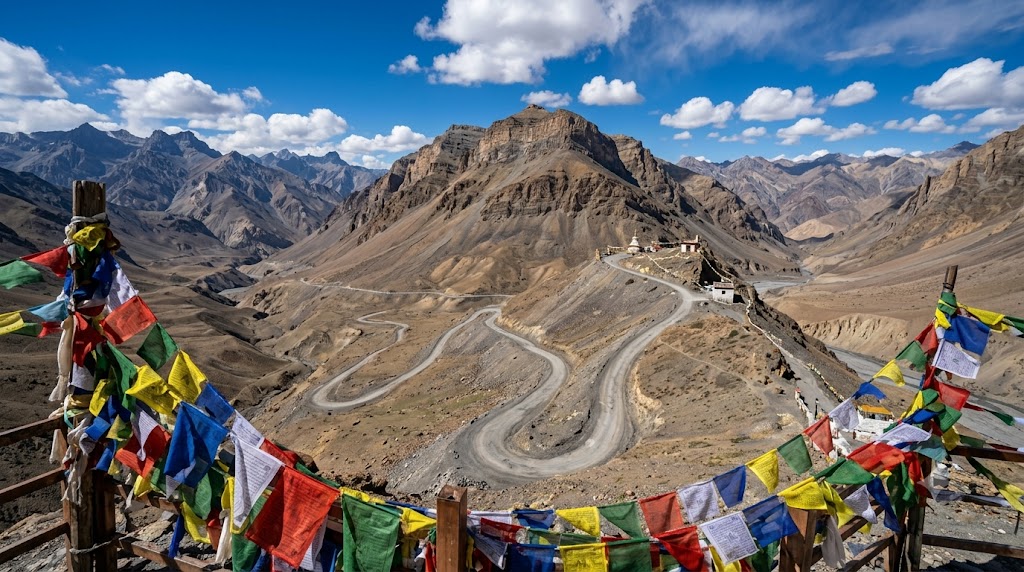
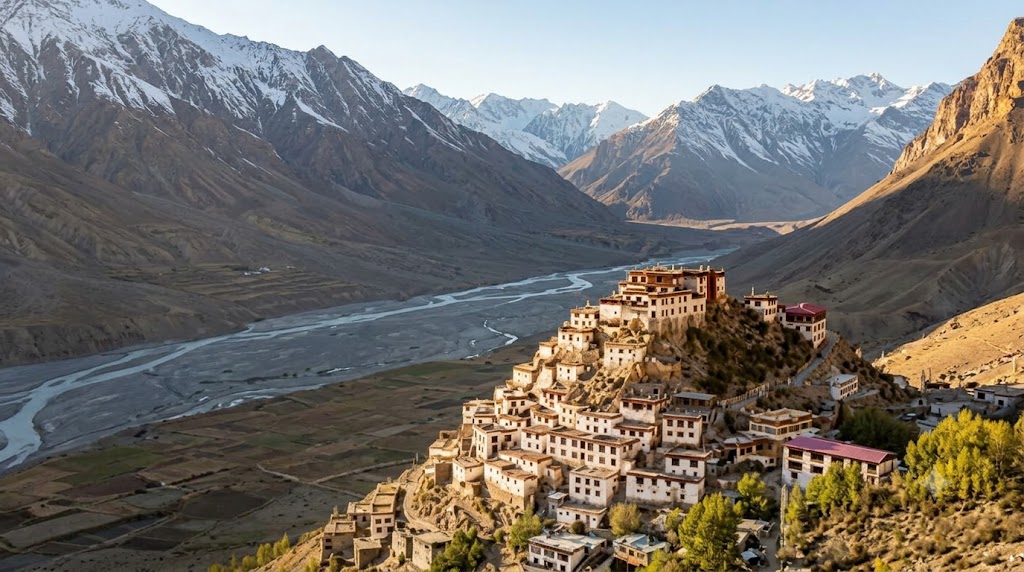
Not every trip from Chandigarh needs to be a beach or a shrine — sometimes it needs to be a road disappearing into a landscape that looks like nowhere else in India. That’s Spiti Valley: a high-altitude cold desert in Himachal Pradesh, all bare brown mountains, whitewashed monasteries clinging to cliffs, and villages that feel closer to Tibet than to Chandigarh, even though the drive starts right here. At Flywings Tour & Packages Pvt Ltd, we’ve watched Spiti go from a hardcore-backpacker secret to one of the most-asked-about road trips in the Tricity — and the season window that makes it possible is closing faster than most travellers realise. Here’s everything to know before you go, from route choice to altitude sickness, written for someone who has never done a Himalayan road trip before.
Is Spiti Valley the Right Trip for You?
Before the logistics — an honest check, because Spiti isn’t Shimla with better views:
- Say yes if: you want dramatic, stark landscapes over lush greenery, don’t mind long driving days, are comfortable with basic guesthouse comfort in remote villages, and want a trip that feels like an achievement, not just a holiday.
- Think twice if: you have very young children, anyone in the group has a heart or lung condition (altitude matters — more on this below), or your idea of a hill trip is a resort with room service.
- The reward: monasteries over a thousand years old, some of the world’s highest motorable villages, night skies with more stars than most Indians have ever seen, and a road trip story that outlasts every beach photo.
The Season Window — Why Timing Matters More Here Than Anywhere Else
Spiti isn’t a year-round destination the way Shimla or Manali are. High mountain passes close with snow, and the full circuit genuinely only works within one window:
| Period | Status |
|---|---|
| November – May | Manali route closed by snow; Shimla-Kinnaur route technically open but needs 4×4/snow chains and real cold-weather experience |
| Mid-June – Mid-October | The full circuit window — both entry routes open, this is when 95% of travellers should go |
| July – August | Warmest, but the Kinnaur side can see monsoon landslides — the Manali side stays comparatively drier since Spiti sits in a rain shadow |
| September | The sweet spot — golden poplar trees, clear skies, thinning crowds, and rates that soften after the August peak |
If you’re reading this in mid-to-late summer, the practical message is simple: the window is open right now, but it closes by mid-October — this is genuinely a “plan this month, not next spring” trip if you want to go this year.
Two Ways In: Shimla-Kinnaur vs Manali
Both routes start from the Chandigarh side of Himachal, and each gives a completely different trip:
| Route | Character | Best For |
|---|---|---|
| Shimla → Kinnaur → Kaza | Longer, more gradual altitude gain along the Sutlej river valley, passing Kalpa and Chitkul | Better acclimatisation, first-timers, those wanting Kinnaur’s greener scenery en route |
| Manali → Kunzum Pass → Kaza | Shorter but steeper, crossing high passes quickly | Time-limited trips, those who’ve already acclimatised, combining with a Manali stop |
Our recommendation for a first Spiti trip: enter via Shimla-Kinnaur and exit via Manali (or vice versa) if your schedule allows — you see both faces of the region and gain altitude more gradually, which matters far more than most travellers expect.
Permits: Simpler Than You’ve Heard
Indian tourists do not need a special permit for most of Spiti Valley — including Kaza, Tabo, Key Monastery, Kibber and Chandratal — which surprises many first-timers who’ve heard permit horror stories from other border regions. Foreign nationals do need an Inner Line Permit for the Spiti and Kinnaur region, arranged at the DC office in Shimla or Kaza, or via the Himachal Pradesh e-permit portal. For Indian travellers, the paperwork is refreshingly light — carry a government photo ID, as with any domestic trip.
A Realistic 7-Day Itinerary
- Day 1 — Chandigarh to Shimla/Narkanda: A relatively easy driving day to start gaining altitude gradually.
- Day 2 — Onward to Sarahan or Kalpa (Kinnaur): Following the Sutlej valley, with Kinnaur Kailash views opening up as you climb.
- Day 3 — Kalpa to Nako: Crossing into the drier, starker Spiti-side landscape — the transformation is dramatic and sudden.
- Day 4 — Nako to Kaza via Tabo: Stop at Tabo Monastery, over a thousand years old, before reaching Kaza, Spiti’s small “capital”.
- Day 5 — Kaza local circuit: Key Monastery, Kibber (one of the world’s highest motorable villages), and Chicham bridge.
- Day 6 — Kaza to Chandratal (seasonal) or straight toward Manali: The moon-lake Chandratal, when road conditions allow, or a direct push toward Kunzum Pass.
- Day 7 — Over Kunzum Pass to Manali: The dramatic exit route, ending in Manali’s relative comfort before the drive home to Chandigarh.
This can be tightened to 5–6 days for a faster trip, but Spiti punishes rushing more than most destinations — the roads are slow by nature, and altitude needs the buffer days built in.
Altitude and Safety: The Section Not to Skip
Spiti’s villages sit between roughly 3,000 and 4,500+ metres — genuinely high altitude, where altitude sickness (AMS) is a real, common risk, not a rare edge case:
- Gain altitude gradually. This is the single biggest reason we recommend the Shimla-Kinnaur entry for first-timers — it climbs in stages rather than jumping straight to Kaza’s altitude.
- Hydrate more than feels necessary. Dehydration worsens AMS symptoms; drink water constantly through the trip, not just when thirsty.
- Know the warning signs: headache, nausea, dizziness and breathlessness beyond normal exertion. Mild symptoms mean rest and hydration; worsening symptoms mean descend — don’t push through.
- Avoid alcohol and heavy exertion on your first day or two at altitude, however tempting the views are for a trek.
- Travel with a driver who knows the region. Local drivers recognise AMS symptoms early and know exactly where the nearest lower-altitude town is — this is not a route to self-drive on a first attempt.
- Carry basic medication as advised by your doctor before the trip, and know where the nearest medical points are along your route.
Beyond the Main Circuit: Worth the Detour
- Dhankar Monastery and Lake: a cliffside monastery even more dramatically perched than Key, with a short hike up to a glacial lake — often skipped by rushed itineraries, which is exactly why it’s worth the detour.
- Pin Valley: a side valley known for its stark beauty and as habitat for the elusive snow leopard in winter — a full-day detour for travellers with an extra day to spare.
- Langza, Komic and Hikkim: a trio of villages near Kaza famous for fossil-hunting, one of the world’s highest motorable villages, and (in Hikkim’s case) the world’s highest post office — a fun half-day loop from Kaza.
- Chandratal Lake: the “Moon Lake”, reachable via a seasonal side road — camping here under Spiti’s night sky is, for many travellers, the single best memory of the trip when road conditions allow it.
Food and Connectivity on the Road
Kaza has the region’s best range of small cafés and guesthouse kitchens, serving a mix of simple Himachali, Tibetan (think momos and thukpa) and traveller-friendly food — don’t expect variety once you’re beyond Kaza’s handful of villages, and pack some snacks for long driving days. Mobile network is limited to patchy BSNL coverage in places and largely absent between towns, so tell family back home to expect radio silence for a day or two — this is very much part of Spiti’s appeal, not a flaw to work around.
What to Pack
- Serious layering: daytime sun is strong, nights drop close to freezing even in summer.
- Sunscreen and sunglasses: UV exposure at altitude is significantly stronger than at sea level.
- A power bank and offline maps: mobile network is patchy to non-existent through much of the route.
- Cash: ATMs are scarce beyond Kaza; carry enough for the whole circuit.
- A basic medical kit including any AMS medication discussed with your doctor.
Booking a Package vs Self-Driving
Spiti is one region where we actively steer first-timers away from self-driving unless someone in the group has real mountain-driving experience — the roads are narrow, altitude affects judgement more than people expect, and breakdown support is thin between towns. A Flywings Spiti package handles the vehicle (with an experienced local driver), homestay/guesthouse bookings matched to each night’s altitude, and a pace that respects acclimatisation — the same logic we apply to Kashmir and Himachal weekend trips, extended to Spiti’s more demanding terrain.
Frequently Asked Questions
What is the best time to visit Spiti Valley from Chandigarh?
Mid-June to mid-October is the full circuit window, with September standing out as the sweet spot — golden autumn colours, clearer skies, and thinner crowds than the July–August peak. Outside this window, mountain passes close and the trip becomes far more difficult or impossible for most travellers.
How many days are needed for a Spiti Valley trip?
7 days covers the classic circuit comfortably with acclimatisation built in — Shimla-Kinnaur entry, Kaza-area sightseeing, and a Manali exit over Kunzum Pass. It can be tightened to 5–6 days, but we don’t recommend rushing the altitude gain.
Is Spiti Valley safe for families with children?
It depends more on altitude tolerance than age — Spiti’s high elevation genuinely affects some people regardless of fitness. Families with older children who acclimatise well can have a wonderful trip; we’d advise caution with very young children and recommend discussing the itinerary with a doctor beforehand if anyone has a heart or lung condition.
Do Indian tourists need a permit for Spiti Valley?
No special permit is required for Indian nationals to visit Kaza, Tabo, Key Monastery, Kibber or Chandratal — just a government photo ID, as with any domestic trip. Only foreign nationals need an Inner Line Permit for the region.
What is the distance from Chandigarh to Kaza?
Roughly 450–470 km depending on the route, but Himalayan road distance is measured in hours, not kilometres — expect the drive (spread across multiple days with overnight stops) to take 3–4 driving days each way via either entry route, not a single push.
Which route is better for a first-time visitor — Shimla-Kinnaur or Manali?
Shimla-Kinnaur, for most first-timers — it gains altitude more gradually along the Sutlej valley, which meaningfully reduces AMS risk compared to Manali’s steeper, faster climb over high passes. If your schedule allows, entering via one route and exiting via the other gives you the best of both without doubling back.
Can Flywings arrange a Spiti Valley trip with a driver?
Yes — we arrange the vehicle with an experienced mountain driver, altitude-appropriate guesthouse stays, and a paced itinerary, as a complete package from Chandigarh. Tell us your dates and group size for an itemised quote.
The Window Is Open — For Now
Spiti rewards travellers who plan a little and respect the altitude a lot. With the season closing by mid-October, the right time to start planning is now, not after the passes shut for winter. Explore more of our India tour packages from Chandigarh, or talk to our desk directly:
- Call / WhatsApp: +91 99143 10333 · Landline: 0172-4736185
- Email: sales@flywingstour.co.in
- Visit us: SCF 29, First Floor, Phase 7, Mohali (Chandigarh Tricity) — get directions
Written by Sukhjinder Kaur, Senior Travel Content Writer at Flywings Tour & Packages Pvt Ltd — planning road trips and holidays from Mohali, Punjab since 2013. Route and season information verified as of July 2026; mountain road conditions change with weather, so confirm current status before you travel.
Sukhjinder Kaur is a premium travel content writer specialising in the tourism industry. She writes Flywings' destination guides, fare-saving playbooks and visa explainers — every piece researched with the agency's ticketing and visa desks before it is published.
View full profile