Let us clear up something several websites currently get wrong: Uzbekistan is not visa-free for Indian travellers. It is close, an entirely online e-visa, no embassy visit, roughly 20 US dollars, but “close to effortless” and “free” are different claims, and a genuine amount of confusion is circulating about which one applies. Uzbekistan is having a real moment regardless, on track for around 12 million visitors in 2026 and a 22.6 percent jump in foreign arrivals in just the first seven months of the year, with India named specifically among its fastest-growing source markets. This guide starts by getting the visa fact straight, then walks through the four-city relay almost every well-planned Uzbekistan trip actually follows. Most existing “Uzbekistan package from Chandigarh” content is a generic OTA city page listing hotel deals without addressing either the visa confusion or the actual flight routing from this region, which is exactly the gap this guide is built to close.
Quick context: Uzbekistan requires a paid e-visa for Indian citizens, applied for entirely online at the official government portal, roughly 20 US dollars, typically approved within 3 to 4 working days. It is straightforward, but it is not free, and it is not visa-on-arrival by default.
The Visa, Correctly Explained
| Detail | Accurate 2026 Information |
|---|---|
| Process | Standard e-visa, applied for entirely online at the official portal, e-visa.gov.uz |
| Cost | Approximately USD 20, paid online by card |
| Processing time | Typically 3 to 4 working days for standard processing; an expedited option exists for travellers needing it faster |
| Recommended lead time | Apply 5 to 7 working days before travel to leave buffer for any issues |
| Documents needed | Passport scan, a recent photo, and standard travel details, entered directly on the portal |
Apply only through the official e-visa.gov.uz portal. Several third-party sites offer to process this for you at a marked-up fee, unnecessary given how straightforward the direct application is. If you have read elsewhere that Indians can enter Uzbekistan visa-free, that claim is not accurate for a standard tourist visit and appears to stem from confusion with Uzbekistan’s separate transit and UAE-residency-linked entry provisions, which apply only to specific traveller categories, not the general Indian tourist case.
Where the confusion likely comes from: Uzbekistan does offer genuinely visa-free entry to a large list of other nationalities, and it offers a 5-day visa-free transit provision for travellers passing through to a third country. Neither of those applies to a standard Indian tourist flying in specifically to visit Uzbekistan itself, and conflating the two is the most common factual error we found while researching this guide across a dozen existing “Uzbekistan visa for Indians” articles, several of which contradicted each other on the same page.
Why the Timing Makes This a Genuine Discovery Right Now
Central Asia as a whole is having a moment among Indian travellers this year, Georgia’s search growth and Uzbekistan’s arrival numbers are part of the same broader shift toward destinations that feel like a genuine discovery rather than a well-worn circuit. Uzbekistan specifically stands out within that shift for one practical reason most of the coverage misses, the flight time from Delhi is shorter than a flight to several destinations within Southeast Asia, which makes it one of the most accessible “new” international options currently available to a North Indian traveller.
Getting There: A Genuinely Short Flight
This is an underrated part of Uzbekistan’s appeal. IndiGo and Uzbekistan Airways both operate direct flights between Delhi and Tashkent, with roughly 19 weekly departures between them, and the flight itself takes under three hours, comparable to a domestic flight time within India. From Chandigarh, that means a short domestic hop to Delhi followed by one of the shortest international legs of any of the emerging destinations we cover, no long-haul fatigue before the trip has even started.
The Four-City Relay
Uzbekistan’s appeal is built around four historic Silk Road cities, and the country’s layout means these are best travelled as a relay, one direction, rather than a hub-and-spoke pattern from a single base.
Stop One: Tashkent, 1 to 2 Days
The modern capital and your likely arrival point, Tashkent mixes Soviet-era architecture, including its striking metro stations that double as an unofficial art gallery, with the Chorsu Bazaar and a handful of surviving old-town madrasas. Most travellers treat it as a brief orientation stop before heading into the more historic cities, though the metro alone is worth a half day for architecture enthusiasts.
Stop Two: Samarkand, 2 Days
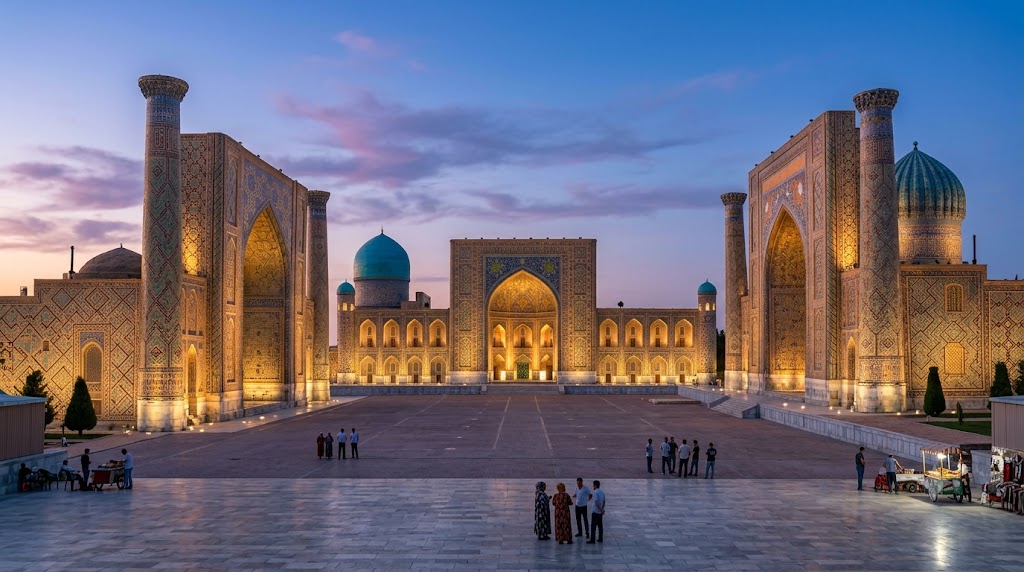
The single most essential stop on the entire route. Registan Square, three ornate madrasas covered in turquoise and blue tilework facing each other across a grand square, is one of the most photographed sights on the Silk Road and genuinely lives up to the images. Gur-e-Amir, the mausoleum of Timur (Tamerlane), and the Shah-i-Zinda necropolis, a corridor of intricately tiled tombs, round out a city that alone justifies the trip for a lot of first-time visitors.
Stop Three: Bukhara, 2 Days
A UNESCO World Heritage old town roughly 2,500 years old, and the most atmospheric of the four cities to simply walk through without a fixed itinerary. The Kalyan Minaret, the Ark Fortress, and a compact old-town core small enough to explore almost entirely on foot make Bukhara the city most travellers describe as their favourite once the trip is over, even though Samarkand tends to win on individual monuments.
Stop Four: Khiva, 1 to 2 Days
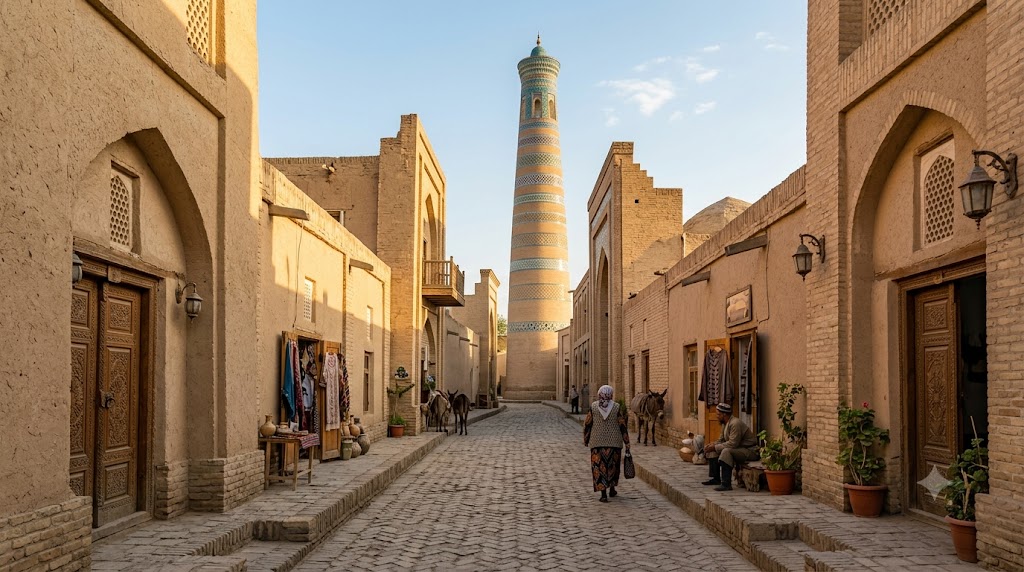
The furthest and most logistically demanding stop, a walled desert city and the best-preserved historic centre in the region, small enough to feel like an open-air museum. Given the distance involved, roughly 1,000 kilometres from Tashkent, Khiva is the city most commonly dropped from shorter itineraries, worth including only if your trip runs seven days or longer.
How Many Days Do You Actually Need
| Trip Length | Recommended Shape |
|---|---|
| 5 to 6 days | Tashkent, Samarkand, and Bukhara, skipping Khiva given the distance |
| 7 to 8 days | All four cities, the classic relay route and the most commonly booked length |
| 10 or more days | The full relay at a slower pace, with extra time in Bukhara specifically, or a side trip to the Fergana Valley for travellers interested in Uzbekistan’s craft and silk-weaving traditions |
Domestic connections between the four cities run on a mix of high-speed rail, the Afrosiyob train between Tashkent and Samarkand in particular is fast and comfortable, and domestic flights for the longer Bukhara-Khiva or Khiva-Tashkent legs, both reasonably efficient and part of why covering all four cities in a single trip stays realistic even on a shorter schedule.
Extending Further: The Fergana Valley
For travellers with two weeks or more, the Fergana Valley, east of Tashkent, offers a genuinely different side of Uzbekistan from the four-city Silk Road relay. Known for its silk-weaving workshops, particularly in the town of Margilan, and its ceramics tradition in Rishtan, it is less visited than Samarkand or Bukhara and offers a more hands-on, craft-focused travel experience, watching silk being handwoven on traditional looms or ceramics thrown and painted by artisans continuing generations-old techniques. This is a genuine add-on for travellers with time to spare rather than a first-trip essential, but worth knowing about for anyone planning a longer, deeper Uzbekistan visit.
Uzbekistan vs Georgia
Since both are recently trending, relatively new-to-Indian-travellers destinations often considered together, here is the honest comparison.
| Factor | Uzbekistan | Georgia |
|---|---|---|
| Visa | Paid e-visa, roughly USD 20, 3 to 4 day processing | Paid e-visa plus a new 2026 DuVerify step and mandatory insurance |
| Flight from Delhi | Direct, under 3 hours | Direct, roughly 6.5 hours |
| Core appeal | Silk Road architecture and history, desert cities | Mountains, wine country, European old-town feel |
| Best fit | History and architecture-focused travellers, shorter available leave | Nature and mountain-scenery-focused travellers, slightly longer trip |
Our honest read: if flight time and a shorter overall trip matter most, Uzbekistan wins clearly, under three hours in the air is a genuinely different proposition from six and a half. If mountain scenery and a wine-country leg matter more than historic architecture, Georgia remains the stronger pick, and our Georgia guide covers exactly what that trip looks like in practice.
Best Time to Visit
| Window | Conditions |
|---|---|
| March to May | Spring, mild temperatures, considered one of the two best windows |
| September to early November | Autumn, similarly mild and comfortable, the other best window |
| June to August | Genuinely hot, particularly in Bukhara and Khiva’s desert settings, workable but not the peak experience |
| December to February | Cold, especially at night, but manageable for travellers prioritising thinner crowds over comfort |
A Sample 8-Day Itinerary
This is the shape most of our Chandigarh clients end up booking, the full four-city relay paced to avoid feeling rushed on any single leg.
- Day 1: Arrive Tashkent, evening at Chorsu Bazaar and the old-town madrasas
- Day 2: Tashkent metro architecture tour, Amir Timur Square, board the Afrosiyob high-speed train to Samarkand in the afternoon
- Day 3: Full Samarkand day, Registan Square, Gur-e-Amir mausoleum, Bibi-Khanym Mosque
- Day 4: Shah-i-Zinda necropolis in the morning, drive or train to Bukhara in the afternoon
- Day 5: Full Bukhara old-town day, Kalyan Minaret, Ark Fortress, unhurried walking through the historic core
- Day 6: Domestic flight to Khiva, evening walk through the walled old city
- Day 7: Full Khiva day, Itchan Kala fortress walls, Kalta Minor minaret
- Day 8: Domestic flight back to Tashkent, departure
This routing avoids unnecessary backtracking, moving in one direction through the country rather than returning to Tashkent between every stop, which most well-planned Uzbekistan itineraries follow for exactly this reason.
What to Eat
Uzbek cuisine reflects its Silk Road position, a genuine crossroads of Persian, Turkic, and Russian culinary influence.
- Plov (osh), Uzbekistan’s national dish, a rice pilaf cooked with meat, carrots, and onions, with regional variations across each of the four cities worth comparing as you travel
- Shashlik, skewered grilled meat, a staple across every city and a reliable, familiar option for most travellers
- Somsa, a baked pastry filled with meat or pumpkin, similar in spirit to a samosa and an easy, comforting snack between sightseeing stops
- Non bread, a round, decoratively stamped flatbread baked in a clay oven, sold everywhere and central to Uzbek hospitality traditions
- Green tea, served constantly and considered a hospitality ritual as much as a beverage, refused refills are considered mildly impolite in traditional settings
Vegetarian travellers should plan ahead, meat features heavily in traditional Uzbek cooking, though larger city restaurants in Tashkent and Samarkand increasingly offer vegetarian options, and it helps to flag dietary needs to your guide in advance, particularly in Khiva and Bukhara’s smaller old-town eateries.
Who This Trip Genuinely Is Not For
Worth saying honestly. If beach time or resort infrastructure is the priority, Uzbekistan is landlocked and offers none of that, this is a history-and-architecture trip first and foremost. If a traveller wants minimal walking, several of the old-town cores, particularly Bukhara and Khiva, are best explored on foot over cobblestone streets, genuinely rewarding but not ideal for anyone with significant mobility concerns. And summer heat in Bukhara and Khiva specifically can be intense, worth avoiding for anyone particularly heat-sensitive. For travellers drawn to history, architecture, and a destination that still feels like a genuine discovery relative to more established international circuits, it delivers exactly what the current surge in interest suggests.
Packing and Practical Notes
- Uzbek Som is the local currency; cards are increasingly accepted in Tashkent and Samarkand hotels but carry cash for smaller cities and local bazaars.
- Dress modestly for mosque and madrasa visits, shoulders and knees covered, consistent with general Central Asian and Islamic cultural norms.
- Comfortable walking shoes matter more here than almost any other destination we cover, given how much of the experience in Bukhara and Khiva specifically happens on foot over uneven old-town stone streets.
- English is spoken reasonably well in tourist-facing roles in the four main cities, though Russian remains the more widely understood second language generally, worth knowing if you are travelling with someone who speaks it.
Uzbekistan for Family and Group Trips
The four-city relay works reasonably well for family groups, given the country’s overall safety reputation and the manageable walking distances within each old-town core, though the Khiva leg’s distance and the desert heat outside the spring and autumn windows are worth weighing for very young children or older travellers with limited stamina. For groups of friends and history-interested travellers specifically, the combination of dramatic architecture, a genuinely low cost relative to comparable Western destinations, and a short flight time makes this an increasingly popular pick for a first “off the usual list” international trip, distinct from the standard Dubai-Thailand-Bali rotation most groups default to.
Cost Shape, Without Fixed Numbers
We are not publishing fixed price tags, since cost varies with season and hotel category, but the relative shape is favourable. Uzbekistan generally runs noticeably cheaper than a comparable Western European Silk Road-adjacent trip, and the short direct flight from Delhi keeps the airfare component reasonable too. Domestic rail and flight connections between the four cities are inexpensive by Indian standards, which is part of why the full four-city relay stays realistic even on a mid-range budget. Reach out and we will build a real, itemised quote for your dates within 24 hours, no obligation.
Why the Timing Is Good Right Now
Uzbekistan’s tourism infrastructure is genuinely still catching up to its own arrival growth, more hotels, more high-speed rail capacity, and more direct flight options are all being added through 2026, which means the destination currently offers a combination that tends not to last, real historical significance and dramatic architecture without the crowd density or pricing that a more mature tourist circuit eventually develops. Booking in the next year or two, while Delhi-Tashkent flight capacity is still expanding rather than fully mature, means better availability on the Afrosiyob high-speed train’s premium seating and the boutique heritage hotels in Bukhara and Khiva that tend to book out fastest as more travellers discover the route.
Frequently Asked Questions
Is Uzbekistan really visa-free for Indians?
No, this is a commonly repeated inaccuracy. Indian citizens need a standard paid e-visa, applied for entirely online, typically approved within 3 to 4 working days. Visa-free entry only applies to specific categories such as Indian nationals holding valid UAE residency, not the general tourist case.
Is there a direct flight from Chandigarh to Uzbekistan?
Not from Chandigarh directly, but Delhi has direct flights to Tashkent on both IndiGo and Uzbekistan Airways, taking under three hours, so the trip is a short domestic hop to Delhi followed by one of the shortest international legs available among comparable emerging destinations.
How many days does a Uzbekistan trip need?
Seven to eight days covers the full four-city relay, Tashkent, Samarkand, Bukhara, and Khiva, comfortably. Five to six days works well if you skip Khiva given its distance from the other three cities.
Which city should not be skipped if time is limited?
Samarkand. Registan Square alone is worth the trip for most first-time visitors, and it is the single most recognisable and photographed site anywhere on the Uzbekistan Silk Road route.
Is Uzbekistan safe for solo and women travellers?
Yes, Uzbekistan is frequently cited as one of the safer countries in the region for tourism, with low reported crime rates along the main Silk Road circuit and a well-established tourist infrastructure in all four cities.
Is Uzbekistan good for a honeymoon?
Yes, particularly Bukhara’s walkable old town and Khiva’s atmospheric walled city, both of which offer a slower, more intimate pace than Tashkent or Samarkand and have become an increasingly popular pick among Indian honeymooners drawn to the Silk Road’s history and architecture.
Can vegetarian Indian travellers manage in Uzbekistan?
With some planning, yes, though it takes more effort than in a destination with a stronger vegetarian food culture. Larger city restaurants in Tashkent and Samarkand increasingly cater to vegetarian diets, and flagging the requirement to your guide in advance helps considerably in the smaller old-town eateries of Bukhara and Khiva.
Is the high-speed train between cities comfortable and worth using?
Yes, the Afrosiyob high-speed train connecting Tashkent and Samarkand in particular is modern, comfortable, and considerably faster than driving, and it has become a genuine part of the travel experience rather than just a transport link, worth booking in advance for the better seat classes during peak season.
Get the Visa Facts Right Before You Book
A trip built on the wrong visa assumption is the single most avoidable way to derail an Uzbekistan booking, and it is worth confirming current requirements directly rather than trusting the first search result. Explore more international tour packages from Chandigarh, or call us directly at +91 99143 10333 for an itinerary with the e-visa timeline built in correctly from the start, whether that is a compact five-day Tashkent-Samarkand-Bukhara trip or the full eight-day relay through all four Silk Road cities. Flywings team since 2013.
Sukhjinder Kaur is a premium travel content writer specialising in the tourism industry. She writes Flywings' destination guides, fare-saving playbooks and visa explainers — every piece researched with the agency's ticketing and visa desks before it is published.
View full profile